
Recent Highlights
Into the Fold
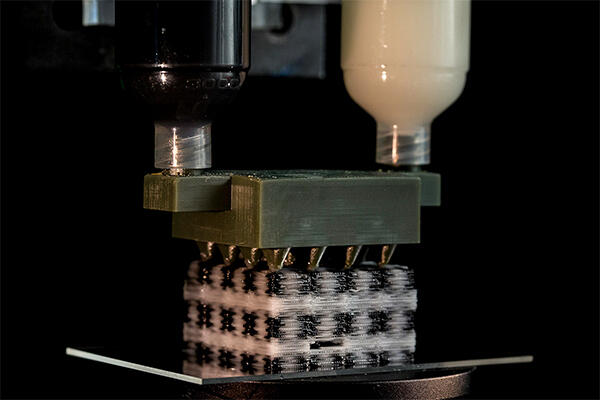
To create a 3-D structure, researchers in Illinois start by printing slow-drying ink of metal or ceramic particles into flat sheets (left). Such sheets can be folded and refolded into 3-D shapes as long as the ink does not dry completely.
Particle-free silver ink prints small, high-performance electronics
Electronics printed on low-cost, flexible materials hold promise for antennas, batteries, sensors, solar energy, wearable devices and more. Most conductive inks rely on tiny metal particles suspended in the ink. The new ink is a transparent solution of silver acetate and ammonia. The silver remains dissolved in the solution until it is printed, and the liquid evaporates, yielding conductive features.
March 2011: Advanced Materials: Small 3D Antennas
While most electronic components benefit from decreased size, antennas - whether in a cell phone or on an aircraft - suffer limitations in gain, efficiency, system range, and bandwidth when their size is reduced below a quarter-wavelength. "Omnidirectional printing of metallic nanoparticle inks offers an attractive alternative for meeting the demanding form factors of 3D electrically small antennas (ESAs)," stated Jennifer A. Lewis, the Hans Thurnauer Professor of Materials Science and Engineering and director of the Frederick Seitz Materials Research Laboratory at Illinois.
"To our knowledge, this is the first demonstration of 3D printed antennas on curvilinear surfaces," Lewis stated. The research findings and fabrication methods developed by Bernhard, Lewis, and their colleagues are featured in the cover article of the March 18 issue of Advanced Materials ("Conformal Printing of Electrically Small Antennas on Three-Dimensional Surfaces"). more...
May 2010: Advanced Materials: Printed Origami Structures
Origami, the traditional paper art, is a folding technique in which elegant and complex three-dimensional (3D) objects are produced from planar sheets. Significant scientific and technological interest in origami assembly methods have emerged due to the
recognition that nature utilizes controlled folding and unfolding schemes to produce intricate architectures ranging from proteins
to plants. To date, novel folding pathways have been harnessed to fabricate nanoscale DNA-based objects as well as nano- and
mesoscale structures, such as 3D metallic objects and silicon solar cells that are lithographically patterned and spontaneously
folded via surface tension effects. However, the ability to assemble printed structures of arbitrary 3D form, composition,
and functionality with the ease, low cost, and versatility of paper origami has not yet been demonstrated. Here, we combine
direct-write assembly with a wet-folding origami technique to create 3Dshapes that range from simple polyhedrons to intricate
origami forms, which are then transformed to metallic and ceramic structures by thermal annealing. more...
April 2010: NewScientist Tech - Blingtronics: Diamonds are a geek's best friend
The most marketable bling technology might be wrapped into something that you take with you everywhere. It could transform your favourite gadgets, including cellphones and music players - by incorporating them into your clothing. "Rather than carrying your iPod, the whole electronic system could be embedded in your jacket," says Jennifer Lewis, a materials scientist at the University of Illinois at Urbana-Champaign. more...
April 2010: Technology Review: Light, Tough Origami Ceramics
A new way of printing and folding ceramic and metal lattices into miniature structures could lead to novel lightweight engineering structures. The technique involves making latticed sheets from ceramic ink, then folding and heating these sheets to create intricate shapes. The method could be used to make lightweight parts for aerospace applications, complex scaffolds for tissue engineering, and filters and catalysts for industrial chemical production. more...
PopSci: Tiny Titanium Origami Highlights New Method Of Micro-Construction
While three-dimensional printing has come a long way, engineers still struggle with fabricating objects smaller than a quarter. In those small structures, the upper layers crush and distort the weak lower ones. To solve this problem, researchers at the University of Illinois have come up with a novel solution: print out a flat sheet, and then fold it, origami style, into the desired shape. Creating this origami crane as proof of concept, the researchers have hit upon a technique that could produce any number of microscopic medical or mechanical devices through folding, rather than layered printing. more...
February 2010: Emerging Themes in Soft Matter: Responsive and Active Soft Materials
Biomimetic microvascular networks with complex architectures are
embedded in epoxy matrices using direct-write assembly. Fluid
transport in multi-generation bifurcating channels is systematically
investigated and maximum flow efficiency is found to occur when
Murray's law is obeyed. more...
December 2009: Self-healing Networks Mimic Nature
A new method to make complex microvascular networks could revolutionise tissue engineering, claim US scientists.
Nature is full of examples of vascular networks, such as blood vessels in the human body and veins in leaves that transport fluid or other substances to promote growth and healing. Jennifer Lewis at the University of Illinois and colleagues have developed a technique to mimic these networks on a polymer matrix. The polymer system makes it capable of self healing, allowing any cracks or tears to be healed making it stronger and more durable than previous attempts. more...
December 2009: Liquid Driven Folding
Fabrication of 3D electronic structures in the micrometer-to-millimeter range is extremely challenging due to the inherently 2D nature of most conventional wafer-based fabrication methods. Self-assembly, and the related method of self-folding of planar patterned membranes, provide a promising means to solve this problem. Here, we investigate self-assembly processes driven by wetting interactions to shape the contour of a functional, nonplanar photovoltaic (PV) device. A mechanics model based on the theory of thin plates is developed to identify the critical conditions for self-folding of different 2D geometrical shapes. This strategy is demonstrated for specifically designed millimeter-scale silicon objects, which are self-assembled into spherical, and other 3D shapes and integrated into fully functional light-trapping PV devices. The resulting 3D devices offer a promising way to efficiently harvest solar energy in thin cells using concentrator microarrays that function without active light tracking systems. more...
December 2009: Science: Exploiting Evaporation
There are many approaches available to pattern soft materials such as colloidal films, but they often require multiple processing steps and allow deposition of only a few particle layers. A method called evaporative lithography overcomes these limitations, and Harris et al. now show that the method also enables the creation of patterns from binary mixtures of particles. More...
September 2009: Silk Fibroin Waveguides: Biocompatible Silk Printed Optical Waveguides
The cover shows an artistic rendition that merges silk and fiber optics. Supercontinuum white light is guided through a glass optical fiber that surrounds and illuminates silkworm cocoons. The silkworm cocoons shown here are used as the starting point of an extraction process to isolate pure silk fibroin protein in an aqueous solution. The silk is then reconstituted in the form of optical waveguides, as described by Fiorenzo Omenetto and co-workers on p. 2411, opening new opportunities to guide light in an entirely organic and biocompatible material. more...
April 2009: Nature Materials: Printing in all directions
Directing ink through a cylindrical nozzle onto a substrate is a promising method for printing metallic electrodes for electronic devices. Until now, however, the technique has had several restrictions: nozzle clogging, relatively large features (~100 um) and deposition that is constrained to the x–y plane. Jennifer A. Lewis and co-workers have created highly concentrated silver nanoparticle inks that can be printed in three dimensions in air without clogging. more...
March 2009: ScienceDaily: New Silver-based Nanoparticle Ink Could Lead to Better Flexible Printed Electronics
A new ink developed by researchers at the University of Illinois allows them to write their own silver linings.
The ink, composed of silver nanoparticles, can be used in electronic and optoelectronic applications to create flexible, stretchable and spanning microelectrodes that carry signals from one circuit element to another. The printed microelectrodes can withstand repeated bending and stretching with minimal change in their electrical properties. more...
Read the original Science article here.
Technology Review: A Nanoparticle Glue Gun
Flexible printed electronics and solar-cell arrays promise to be cheaper and more versatile than their rigid counterparts. But their components still need to be linked by tiny metal electrodes in order to get electrons flowing through a device. A new silver-nanoparticle ink could be just the thing for printing high-performance electrical connections for flexible devices. More...
This work has also been featured in:
MarketWatch,
Product Design & Development, Science Centric, AZOmaterials,
e! Science News, Nanotechnology Now, PhysOrg,
The Post Chronicle, redOrbit, The Money Times, UPI.com,
insciences.org, Times of the Internet
October 2008: Nature News and Views: Solar cells go round the bend
With high oil prices sparking a surge of interest in alternative energy sources, solar cells have become the subject of intense research. Much of this effort focuses on finding new designs that open up fresh applications. John Rogers and colleagues now report just such a development (J. Yoon et al. Nature Mater. doi:10.1038/nmat2287; 2008) - tiny, ultrathin cells made of silicon that, when fixed in arrays on a flexible substrate, create large, bendy solar cells (pictured). More...
October 2008: New York Times: A New Flexibility With Thin Solar cells
Photovoltaic cells, the basic building blocks of solar panels, are more efficient and less costly than ever. But manipulating cells (which are usually made of semiconductor materials) and incorporating them into different panel designs is not necessarily easy. More...
January 2008: SciAm 50: Material World
Cut your finger, and your body starts mending the wound even before you have had time to go and find a Band-Aid. Synthetic materials are not so forgiving, but Nancy R. Sottos, Scott R. White and their colleagues at the University of Illinois at Urbana-Champaign are looking to change all that. They developed a self-healing plastic that contains a three dimensional network of microscopic capillaries filled with a liquid healing agent. More...
October 2007: Material: Heal Thyself
In a display of nature's restorative powers, human skin has the ability to heal itself when cut. Now, researchers at the University of Illinois have invented materials that do the same thing. More...
October 2007: Sol-gel Inks Produce Complex Shapes With Nanoscale Features
New sol-gel inks developed by researchers at the University of Illinois can be printed into patterns to producage three-dimensional structures of metal oxides with nanoscale features. More...
August 2007: Inverse woodpile structure has extremely large photonic band gap of 25%
The latest photonic device built by researchers at the University of Illinois, a so-called inverse woodpile structure, is made of germanium which has a higher refractive index than silicon. "Until now, all woodpile structures have been composed of solid or hollow rods in an air matrix," said Paul Braun, Professor of Materials Science and Engineering. Their new germanium matrix containing a periodic array of tubular holes has one of the widest photonic band gaps ever reported (as large as 25%). "In many applications, from low-threshold lasers to highly efficient solar cells, photonic crystals with wide band gaps may be required". More...
August 2007: Self-Healing Plastic
ScienCentral News and WBKO - Even high tech machines like the space shuttle need the occasional repair. But what if materials like plastics could repair themselves? As this ScienCentral News video reports, scientists are doing just that by imitating how our bodies work to heal small wounds.
More...
July 2007: Plastics That Seals Its Own Cracks
(BusinessWeek) - Plants and animals can repair themselves thanks to circulatory systems that carry healing agents to wounded tissue. Researchers at the Univ. of Illinois have created a new plastic that fixes itself the same way. The material is embedded with channels about as wide as a human hair. More...
June 2007: Cover of Advanced Materials, Vol. 19, Issue 12
Germanium inverse woodpile 3D photonic crystals with a large (25%) photonic band gap in the infrared (background image) were fabricated through a multistep replication procedure. A polymer scaffold was first created by direct-write assembly, followed by the conformal growth of oxide and semiconductor layers, and removal of the polymer and oxide (foreground), as reported on p. 1567 by Paul Braun, Jennifer Lewis, and co-workers.
Also see solid state and materials research news in Physica Status Solidi (RRL)